
Interviewer: Claire Liu, Grade 9 Student from Unionville High School, Visual Arts Program
Introduction
I am a Grade 9 student who currently attends Unionville Highschool, a school quite dedicated towards the arts. I wanted to learn more about the creative world and what it means to build a career through art. Similarly, I have been working on art through school projects and personal practice, which has helped me build creativity, patience, and confidence in expressing my ideas. At the same time, I have become more curious about how artists find inspiration and turn simple concepts into meaningful works.
To explore this further, I interviewed Nicholas Hoang, an artist whose work reflects both creativity and dedication. Through his artistic journey, he has developed a unique style and perspective, using his skills to communicate ideas and emotions in powerful ways. His work shows how art can go beyond visuals and connect with people on a deeper level. His simple yet effective works can reflect life.
For me, it was inspiring to speak with someone who has connected inspiration throughout his life and demonstrated his effort to grow as an artist. What follows is a transcript of our discussion, edited slightly for clarity while keeping his responses as authentic as possible.
Interviewing this artist, Nick Hoang, I was inspired at his work, and the meaning behind his work. I have never used oil paints in my life, and I was interested in this work, and how he includes many important and real-life feelings into his art.
Q: What materials do you use and why?
Nick Hoang: Because when I went to school for art in college, I was using acrylic. I didn’t pursue art during college far enough to actually experiment with oils. Down the line, I would like to use oils, but as of right now, I’m pretty comfortable with acrylic.
I also use wood panels instead of canvases, because I find wood panels smoother. I integrate the wood grain into my practice. Canvas tends to have this crisscross type of texture that I’m not real fond of.
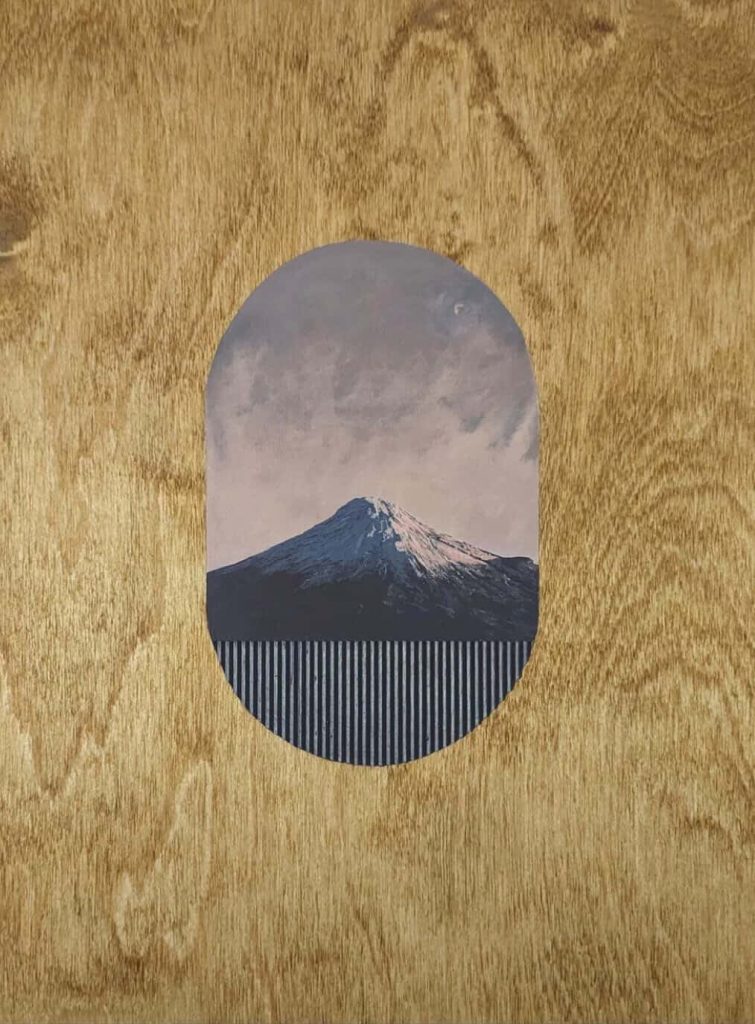
Image Credit
Nick Hoang: https://www.nickhoangart.com/gallery
Q: Is there usually a story behind your work?
Nick Hoang: Recently, I’ve been trying to integrate more meaning into my work. Before, it was mostly things that were very surface level, like things that I just thought looked cool, and I would add them in.
But as I’m trying to dig deeper into my artistic practice, I’m trying to integrate more meaning into my work.
For example, the one behind me here, This one is from Chinatown in Mississauga. It’s where my parents used to take me a lot when I was a kid growing up.
So I want to incorporate that to create a sense of scale on a really big panel, because I wanted it to capture how big this plaza was when I was a baby. But visiting there now, everything seems so small. So that’s why I incorporated it.
And then I added trees and whatnot to make it a little more interesting. That’s not how it actually looks, necessarily, especially the sky. So I integrate a little bit of a different environment to make the painting a little more interesting.
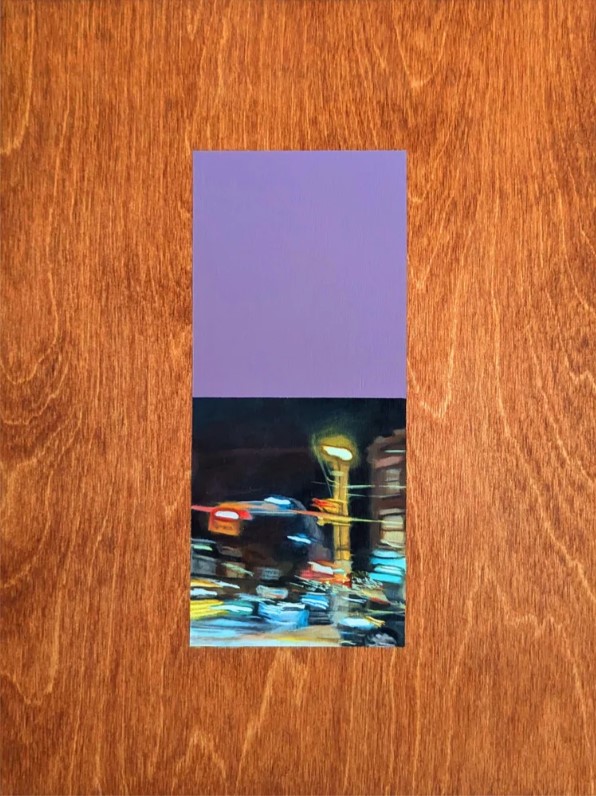
Image Credit
Nick Hoang: https://www.nickhoangart.com/gallery
Q: How do you find your ideas?
Nick Hoang: I try to find them from everything. Whether I go online and look for ideas through Pinterest, or just browse photos and use reference photos to kind of spark something in my mind. Or I’ll go around town.
Like, I’ll go around for solo explorations, whether it’s in Toronto. I’ll take some photos. I’ll browse through my camera roll and see any vacation photos I’ve taken, or family photos I’ve taken, to kind of get some ideas going.
Q: How does negative space affect your wood panel pieces?
Nick Hoang: I like the idea of having negative space.
When I was using wood panels initially, I always felt bad getting over them completely and covering up the wood grain. So I want to incorporate the wood grain itself as negative space into my paintings.
I started experimenting with wood that you would buy from Home Depot. And then recently, I’ve been experimenting with different colours that you normally wouldn’t get from wood grains, through acrylic ink. I think it adds a nice balance between just having an image, because all my paintings have a realistic aspect to them. I didn’t want it to just be another landscape painting or another painting of a building or something.
So I added the wood grain into the piece to make it a little more unique and kind of stand out from other artists out there.
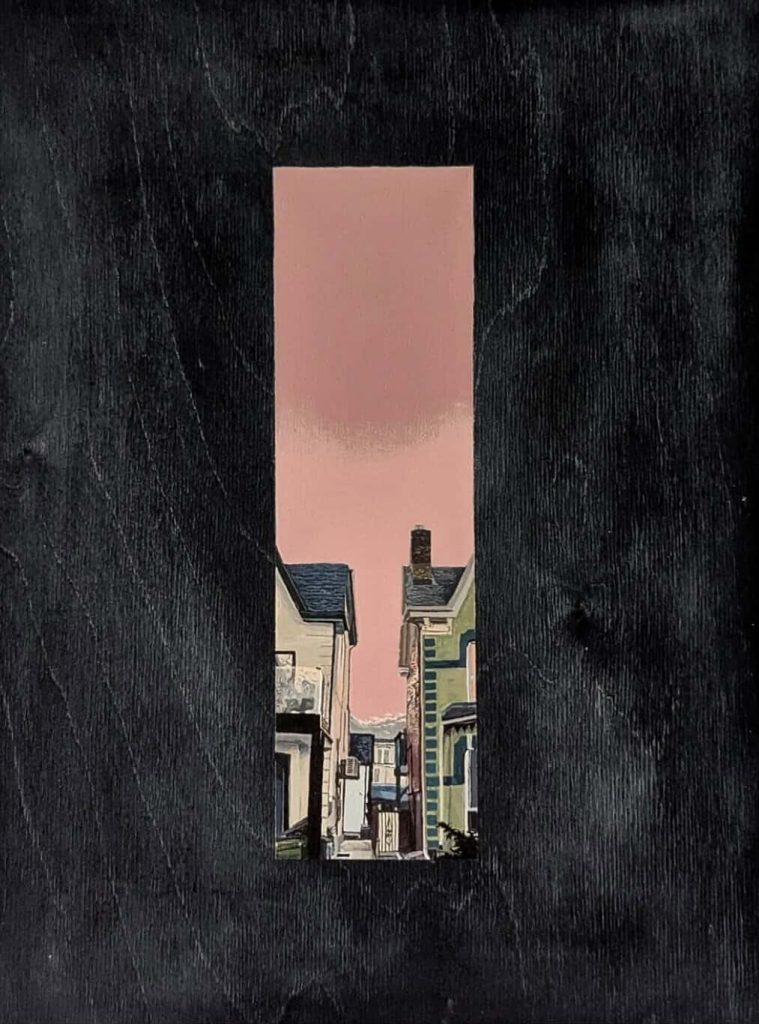
Image Credit
Nick Hoang: https://www.nickhoangart.com/gallery
Q: How long does it take you to finish a painting?
Nick Hoang: Too long, unfortunately.
I wish my process was faster. Maybe in time, I’ll be able to speed up my process. For example, the one behind me, I started in May. But to be fair, I did have a lot of breaks in between. I had to work on those wood panels, the small ones. I had to take a break from this one to work on that one for a show project at a gallery in Markham.
So that part took a few months. The small ones take about a week. Bigger ones can take maybe a few months.
Q: How do you choose your color palette?
Nick Hoang: I initially start off with an initial idea that I put onto the panel. And then I kind of just look at it in a way where it’s almost intuitive.
Sometimes it’s intuitive. Sometimes I’ll go on Google and look for those palette colour generators to get some ideas. Or I’ll go on Pinterest to find colour combinations or images, like, oh, I like the colour of this sky here, and I’ll incorporate it into my work.
And sometimes it works. Sometimes, after I paint it, it turns out like, oh, I wasted a week painting this, and it didn’t look as good as I thought it would, and I have to repaint it. So it’s a lot of trial and error.
Q:How do you feel while you’re creating?
Nick Hoang: Emotions, I don’t know. I kind of go into this state where I don’t really do a lot of thinking. I’m just in the zone. I have music playing in the background or maybe a stream playing, just some background noise.
Usually I don’t feel much during the process. When I finish a portion, I step back and look at it. And I look at it in a very analytical way, like, does this tree pop out enough? Are there enough colours in this one area? Does everything look like it flows together?
So usually I don’t feel much during the process. Usually afterwards, after everything is said and done, I have time to calm down. I can look at the painting and have a little more thought toward the piece.
Q:How do you want viewers to interpret your work?
Nick Hoang: They can interpret it however they want, whether they like it or not.
I’ve been told to my face, like, oh, I’m not into this. And I’m like, I appreciate it. My feelings aren’t hurt.
So they can interpret it however they want, because I don’t want to be the person dictating how they should feel about something. I can give them my insight into what I think about it, or sometimes I don’t.
Sometimes I’m just like, I’m not going to say anything. You guys can figure it out on your own, you know?
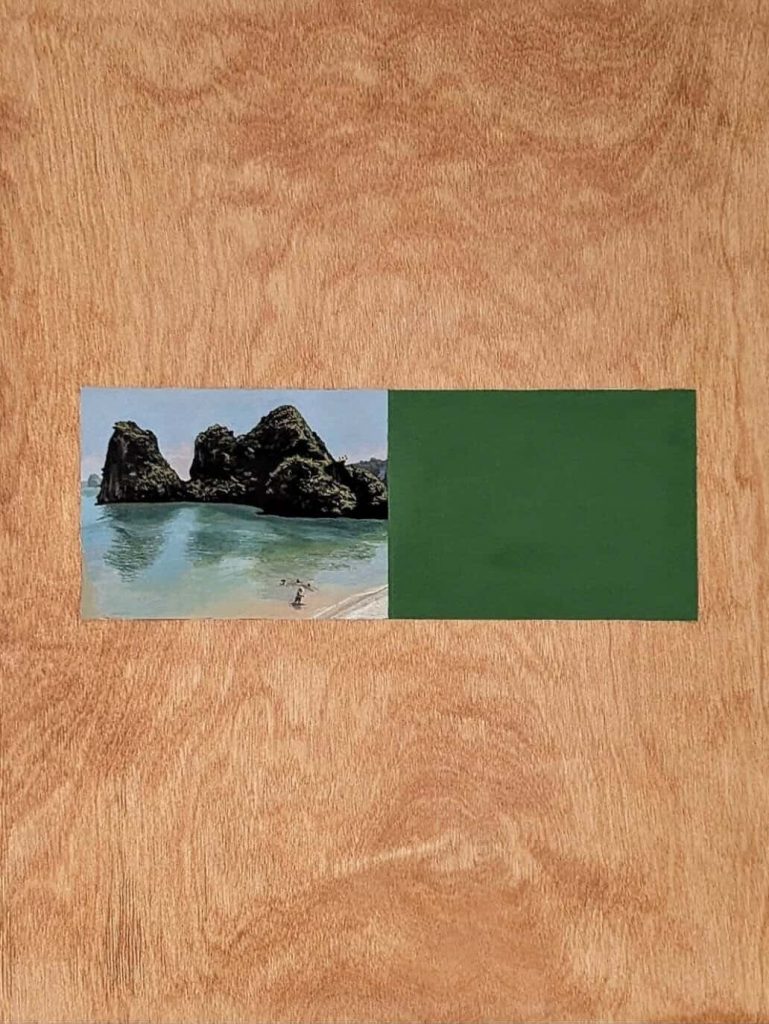
Image Credit
Nick Hoang: https://www.nickhoangart.com/gallery
Q:What advice would you give new artists?
Nick Hoang: I never really thought about it. I would say, just honestly make what you genuinely like making, because I’ve seen people kind of lean into making art for the sake of trying to make money, or what’s popular, or whatnot.
If you have to attach trends to your artwork, I feel like it’s not very genuine.
Don’t be afraid to explore different avenues of art. A lot of my pieces come from combining different disciplines. For example, I have a piece where I incorporate texture, like that white plaster type of finish you’d see in home design. I incorporated that, and then I painted over the plaster to create something a little more interesting.
So don’t limit yourself to a single style of art or a single discipline. I feel like you should look around everywhere you can, and maybe combine things where you have this interesting mix of different disciplines, and then come out with your own unique style.
Because the funny thing is, I thought my style was pretty… I don’t want to say generic, but I felt like it’s been done before. But after going to Artist Project and Toronto Outdoor Art Fair and interacting with other artists in the local scene, people were like, your work is very unique. And I’m like, oh, I didn’t think so. I was just in my own bubble doing my thing and not really caring about what other people were doing around me.
And it turns out my work is pretty unique in a sense.
Q:What have you learned from doing art?
Nick Hoang: I’ve learned to really lean into my ideas, because when I first started, I was very hesitant. I think this is the case with a lot of artists. They’re very hesitant about their ideas and whatnot. But after my first public showing, I got pretty good reception, even though I was kind of iffy about a lot of ideas. So that kind of solidified me just leaning into it. If I really want to make something, I’ll make it. And worst case scenario, if it doesn’t turn out well, I can always make a new painting. It’s not like I’m limited to making twenty paintings and then that’s it, not allowed to make any more. I can make a new one with a different idea.