
Interviewer & Compiler: Claire Liu, Grade 9 Student from Unionville High School, Visual Arts Program
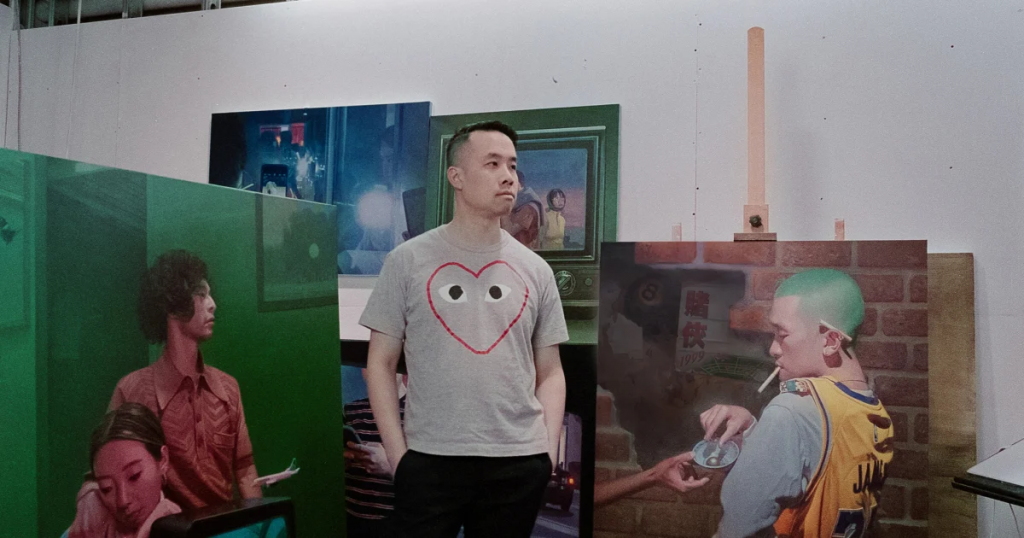
Image Description
Peter Chan – Credit: WOAW Gallery
Introduction
I am a Grade 9 student currently attending Unionville Highschool for their Visual Arts Program. Over these years I have been experimenting with many different types of art mediums and styles. From sculpting with clay to painting with acrylics, I was able to learn many skills. These different styles have taught me patience, creativity as well as enhanced my artistic skills. Although I have used quite a bit of mediums and tried different styles, I am still curious of other styles and mediums I have not come upon or used yet.
To explore more about different styles and mediums, I interviewed Peter Chan, a Canadian artist working in Toronto, whose main medium is oil painting. His work explores many different meanings such as social identity, culture and more. He has been creating art for a while, and many of his artwork has been hung on display in art galleries and festivals. Chan’s artworks influence and inspire many young artists.
Chan received a BAA at Sheridan College in 2008. He also teaches at OCAD university, Sheridan College, and Seneca College. He teaches art to many students, sparking inspiration from his work.
Interviewing this artist, Peter Chan, I was inspired at his work, and the meaning behind his work. I have never used oil paints in my life, and I was interested in this work, and how he includes many important and real-life feelings into his art.
Q: Why did you decide to use oil painting as your medium?
Peter Chan: I went to Unionville High School in Markham, and I was mostly doing acrylic and pencil. Then I went to Sheridan College for my degree, and even there, the school wanted to be super safe because oil painting involves solvents like turpentine, and those can be toxic. If every student had them, it would be too much in the studio environment, so everyone used acrylic.
Throughout those four years, I actually became more like a digital artist. I was really into Photoshop painting and felt like digital was the future. But in my final year, when I was doing my thesis, I had a mentor professor who suggested I try oil. He said it’s a historical medium, and that if I improved in oil, I could learn so much and probably even take my digital work to another level. He was basically like, “You’re graduating, why not? What is there to lose? Try it, and if you don’t like it, it’s okay.”
So I tried it. He advised me on what materials to buy, and I started experimenting. At the same time, I had a classmate who was also trying oil, and we both got really into it. We stayed up at school painting, and it felt like discovering something new. It was like a new video game, it was so fun. We got obsessed with it, trying to learn everything we could, and we kept asking the teacher how to get better.
That was the starting point. That’s how I got into oils initially.
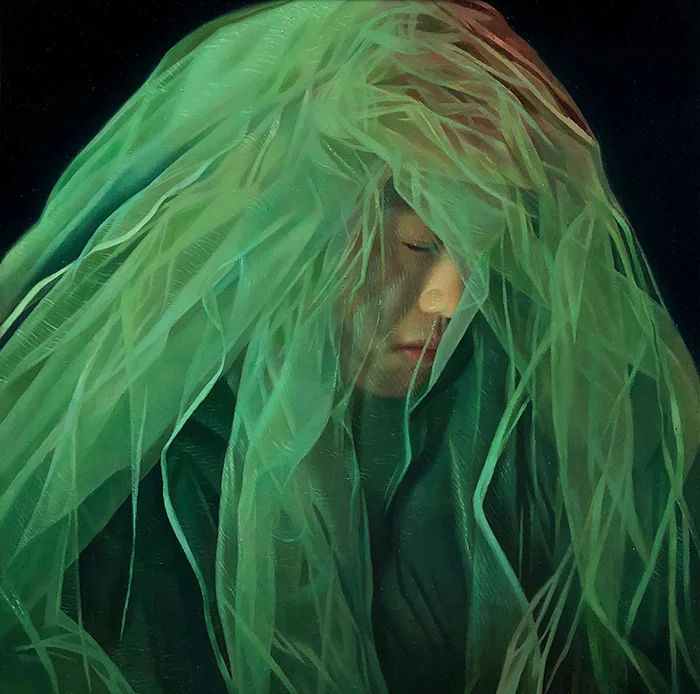
Image Description
Beyond the Veil 3
Oil on panel
Image from Peter Chan
Q: What is your creative process like? How do you find ideas for your art pieces?
Peter Chan: I would say everyday life. One of the most important things in my process is what I call a mind map. I draw or write things down and think about what I personally like. It doesn’t have to be art. It can be music, movies, anything.
That includes my background too. I was born in Hong Kong and immigrated to Canada when I was eight. That part of my childhood plays a big role. The things I watched on TV when I was in Hong Kong, the things I watched after coming to Canada. All of that goes into the mind map.
So I started painting very directly. If I found something interesting, like the TV I grew up watching as a kid, I thought, okay, let’s just paint that. The actual TV my parents brought with us when we immigrated. Or watching my grandmother and aunties play mahjong when I was a kid. I didn’t even understand the game, but it was part of what I grew up with. I started painting those tiles, those objects.
I also studied a lot of art history, both in Unionville and at Sheridan. I learned how artists throughout history leaned deeply into their own interests. For example, Wayne Thiebaud painted American food, cakes, donuts, pastries, obsessively. That’s just him. And I learned that it’s okay to do that. You don’t have to worry about whether it will do well, whether people will like it, or what the industry thinks.
I think that fear is the hardest thing for most people, especially now with social media. I see it with my students too. It holds people back. But once I was okay with letting that go and just focusing on painting my story, things became much smoother. I just painted.
Even now, it’s still strange. I make the work, then I put it out there, and I don’t know what’s going to happen. There will always be people who don’t understand, people who are curious, and people who connect. You feel understood, not just as an artist, but as a human.
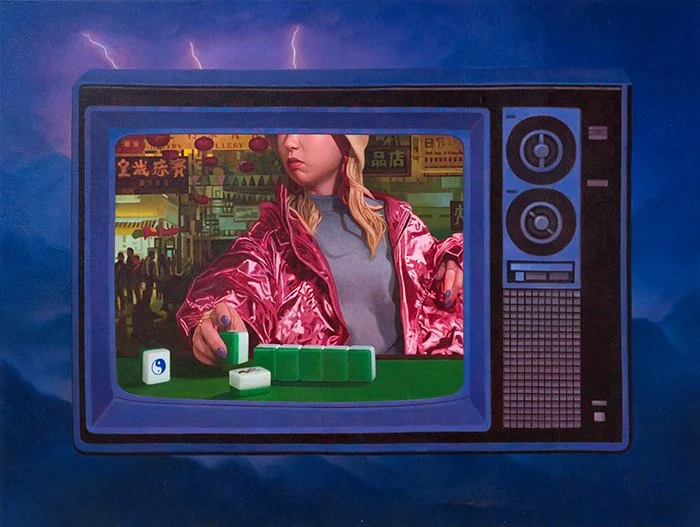
Description
Lightning on Temple Street
Oil on canvas
Image from Peter Chan
Q: When you start a piece, do you have a specific story in mind or does it chance while you paint?
Peter Chan: It changes. Every time it’s different. Sometimes I’ll be sleeping and I’ll have a dream, and I wake up thinking, oh, this is such a cool idea. I’ll write it down, and in my mind I can already see the image very clearly. I’m like, I really want to paint this.
Then a few days later, when I’m back in the studio and I look at it again, I might think, oh, this is so stupid. Maybe this is not good to paint at all. Instead of throwing it away, I just let it sit. I keep sketchbooks where I write notes, do little thumbnail sketches, and composition ideas. If something comes to me wherever I am, I’ll sketch it quickly and let it rest.
Sometimes a while later, I look at it again and think, this is good, I should do this. Then I start building on it. I might start taking photos, gathering objects, even spending a whole day doing a photo shoot with the items. And then while I’m arranging them, I might realize there’s a better way to do it, so the idea changes again.
I usually have a direction, but I stay open. I might think the painting should be red, and then halfway through realize green works better. Sometimes I don’t even know how it’s going to work out. I’m just following a feeling. I might already be halfway into a painting when something from everyday life suddenly clicks. I’ll be out somewhere, or looking at my bookshelf, and think, oh, that’s what’s missing. That symbol.
If I’m stuck, I stop painting and look around. Something always triggers another connection. So the process is very organic, sometimes it’s very direct. I have both a physical sketchbook and a digital one. I keep folders of reference images and Photoshop sketches, and sometimes they sit untouched for months. Then suddenly, at the right moment, they come back and fit exactly where they need to.
Q: How do you choose the colour palettes for your work? Do they have an impact on it?
Peter Chan: Colour has a huge impact. I usually start with colour theory. Things like which colours work well together, how you create contrast, tone, and balance. Basic things, like red and green being opposite colours.
I think about colour the same way people dress. For example, someone might be wearing a beige outfit, and then suddenly they have purple shoes. That’s why it pops. People will be like, “Oh, you’re so fashionable,” but really it’s just basic colour theory. A friend of mine dresses like that, and everyone thinks it’s amazing, but it’s simply understanding contrast. Painting works the same way.
So if a painting has a lot of green, for example, then the opposite colours will really stand out. But usually I start by setting an overall atmosphere. That atmosphere could be green and then I work within that space.
Sometimes I think about how animation studios do it. Like Pixar, when they want something to feel really fun or exciting, they use very strong, contrasting palettes. They often use three main colours to create a very bold, energetic feeling.
For me, colour is about atmosphere and tone. I choose it based on what the image needs. If it’s meant to feel fun, nostalgic, sad, or happy, that will change the palette. Cultural moments matter too. For example, Chinese New Year can be painted in a very lucky, prosperous way, or in a more atmospheric, mysterious way. The colour palette shifts depending on the story and the moment I’m trying to tell.
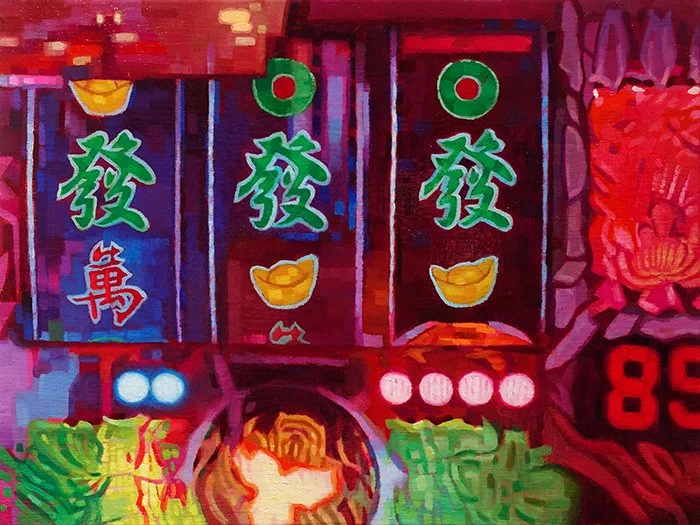
Image Description
Jackpot 2
Oil on panel
Image from Peter Chan
Q: How do you think your art changed over time?
Peter Chan: As I discover more and learn more, my work changes with me. When I began to really commit to painting as a practice, I was focused on specific influences.
In my earlier work, there was a strong Italian sculptural influence. I was looking at a lot of marble sculpture, and I don’t know why I liked it so much, but I was completely fascinated by it. I was studying in New York, I was taught by an Italian painter, and I was surrounded by Italian artist friends both there and in Toronto. I really loved that history, so naturally a lot of my paintings revolved around those ideas, those subjects, and that visual language.
Then, some years later, something clicked. I started wanting to paint more personal things. I began thinking about painting from my own lens, what it means to live here as a Chinese Canadian. I started thinking about Canadian painting history too. Growing up, I went to the Varley Art Gallery and saw Frederick Varley’s paintings, snow scenes and landscapes. Canadian painting, historically, is so tied to landscape. So I started asking myself, what does that mean in my world? What do I see now, living in this time, compared to what painters were seeing in the early 1900s? What’s different, and what do we still have in common?
I started sharing my own very ordinary things. The TVs we had at home, for example. People might ask, why bring that back? But for me, that was my memory. That was my life. I watched a lot of TV because at that time there was no internet, and kids spent most of their time outside. We played sports, we ran around, and when we were inside, especially when my parents were working long days, I watched TV. That’s very specific, very niche, but it’s also very real to me.
So you can see the arcs changing. I explore one thing for two or three years, and then I feel like I’ve explored enough. If I keep going, it might start to feel repetitive. So I move on to something else that I’m interested in. Usually, simultaneously, the films I like change, the music I like changes, and my interests shift.
Your interests shift. But even though things change, there’s still something that stays the same. My early paintings and my current work still have something in common. It’s still me. So I think it’s important to understand that your work will shift, and that it’s not good or bad. It’s just change. It’s normal. It’s interesting. It’s different. And that’s part of being alive and continuing to make work.
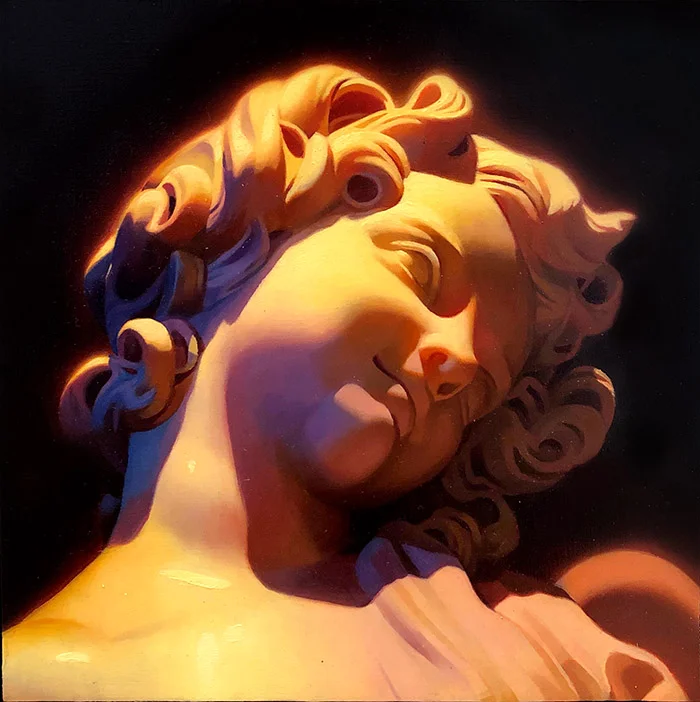
Image Description
Study for Cupid (After Bernini)
Oil on panel
Image from Peter Chan
Q: What have you learnt from doing art?
Peter Chan: I think I learned about life more than anything. Like being okay with change, being okay with presenting yourself, and being vulnerable with your art. You really have to be okay with putting yourself out there, being okay with being judged.
In my case, I feel like I have to be okay with anything. I mean, how people receive the work, whether it’s positive, negative. I have to be okay with all of that. And that’s very scary for artists. I see it with my students too. Sometimes they’re really scared of that, and I get it, because I was there. Putting yourself out there is scary, especially now, especially with social media.
But you kind of have to. Or maybe you don’t have to, but you could. And in my opinion, there’s actually more good that can come out of it than bad, if you develop a sense of boundaries and respect. Respecting yourself, but also respecting other people’s opinions.
If someone doesn’t like your work, that’s okay. They might have a reason. Maybe they just don’t like red. Your painting is red, and they don’t like red. That’s fine. It could be their upbringing, their taste, their interests. It doesn’t have to mean anything more than that.
So I think those are the things you learn. And honestly, they’re not just about art. They apply to anything. It’s just part of living, I think.
Q:What advice would you give to new artists?
Peter Chan: I think the most important thing is something I already mentioned earlier. Writing your journal, trusting your own vision, trusting your own upbringing, and being honest with it. Writing your thoughts down, drawing your own things. You don’t have to show anyone. It can just be your journal, your internal thoughts, imagery, or dreams.
And then looking at it, not to grade yourself, but to self-evaluate. Like, what do you actually like? What are you personally interested in? And sometimes that might not even be art in the way you originally thought.
I have artist friends who started as painters and then changed into different careers that are still art-related, but not painting. Some realized they really liked making images for T-shirts, so they started doing that. Some loved the tactile quality of making paper. Others started as visual artists and then moved into sculpture, or even into music. So it doesn’t have to be one thing. It could be completely different.
I think being open-minded is really important. Studying, learning, having a curious mind. Asking questions like, why are things this way? Not in a good or bad sense, but just wanting to understand more. Why did artists in a certain time period paint the way they did? What was happening around them?
And being open to other people’s stories too, because they can teach you a lot, not just about art, but about life in general. Those are the things that really helped me personally, and that’s what I would recommend to new artists.
Learn more about Peter Chan and his art at: https://peterchanart.com/